Shopping Centers in Hospitals

The most retail sales, per square foot, take place in airports.  20 years ago, you were lucky to have an airport cafe.  Entrepreneurial organizations are now seeing the same growth potential in hospitals.

If organizations like Simply Retail have their way, our Starbucks kiosks will be the tip of the retail sales iceberg.  They are partnering with healthcare organizations to plan retail stores within their hospitals, especially new facilities.

I love the idea.  There are always people looking for time to pass, offering them a shopping experience is a win-win.  If only I could get one of my hospitals to open a Best Buy.

Goodbye FCG

FCG was one of the first “boutique” consulting firms in the healthcare IT (HIT) space. It was founded by the late Jim Reep and Zan Calhoun. Now, it is part of HIT history.

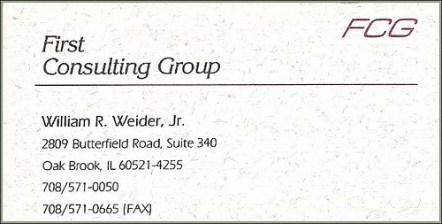
I believe I was at FCG during the golden age. There was not a lot of structure, but there were a lot of talented people figuring out this new industry. We were staying a few steps ahead of our clients. I remember working on a strategy project and we were arguing about the necessity for a PC network as part of the strategy. That’s how young the industry was.My FCG Business Card from 1988

Back in those days (1987 – 1990) Jim and Zan would shut down the entire company for one week and take us on a retreat in San Diego’s Pala Mesa resort. Somewhere I have have a picture of the staff at my first retreat – the first 50 FCG employees.

This was in important time in my life. I gained a lot of self-confidence and learned what it meant to love your work. I also had a lot of great mentors: Zan, Karen Reed, Julie Bonello and Steve Heck. I also loved my peers in the Chicago office: Pete and Andy Smith, Liz Krimendahl, John Hoben and many others. I still cherish my memories of Friday afternoons at Wrigley Field with this cast of characters. Work is great when you have a sense of camaraderie with your co-workers (which is why I am so happy now).

We were a small firm then. I remember our first $1M month. When FCG was sold to CSC they were a much different public company earning many times that. Good times, then. Good times, now.

Your starting pay will be $2.50 per hour

I have never striven for 0% turnover in the departments I manage. I think it is great for new people to enter our organization and bring new ideas and renewed energy. I also think it is good for people to be exposed to different careers, especially when they are young. So, when someone announces their departure I usually accept the news in good spirit. This time was different.

Sue announced that she will be retiring from Affinity Health System in June. She was employee number 2 in the Information Technology department (back then it was data processing). This was several years before we had our first computer. Instead, Sue was responsible for organizing key punch jobs that were sent to a mainframe computer that was shared by several hospitals.

Sue has always kept meticulous records. I always found it ironic that someone with this much IT experience loved her paper records. I suspect she has seen a lot of computer disasters. As proof of this behavior, I submit to you this:

Header from Sue’s Offer Letter

This is the letterhead from Sue’s offer letter which is still in her files. Did you notice the date? I would encourage you to click on the image so you can see the entire offer letter. It includes an attempt to phototcopy a picture of the equipment (graphical printing did not exist). There are some precious historical references here, including:

  • Sue’s starting salary was $2.25 per hour (she makes more now)
  • Sue’s supervisor felt compelled to explain the function of a CRT
  • The Data Processing department consisted of the following state-of-the art hardware:
    • Control Data Corporation (CDC) 200 User Terminal
    • (2) IBM 1050 Data Terminals
    • (2) 029 Key punch machines

Sue, thanks for your years of service. Your willingness to keep learning has allowed you to adapt to multiple generations of technology. More importantly, you have touched many lives, including a lot of patients you never got to meet. Enjoy your much deserved retirement.
I need a consultant

The problem with not using consultants is that when you do want one, they are hard to find.  I had been keeping in touch with Andy Smith since I left FCG 18 years ago.  So, I sent him an email today asking if he could help me with something and his email bounces back from the FCG server.  Sheesh.

So, I am trying to do some good old fashion benchmarking of similar-sized IT organizations.  I know that HIMSS Analytics has some data.  But, I really need a consultant to help me with data gathering on my side and turning that data into some insightful analysis.  My plan is to present this to my IT Customer Advidory Board (aka Steering Committee) in the first week of February.  They have been asking how we compare to similar organizations, which is a good question.

If anyone has an idea who might be good at this please leave a comment here on the blog (so everyone will know).  This is a rare opportunity for a healthcare IT consultant to make a connection with our organization.

Another CIO Junket Offer

When will they learn to stop sending me these inappropriate offers of free travel and resort hotel stays?  Here is the latest one to come into my mailbox.  The rooms at this hotel start at $500 per night.  I am used to the Stevens Point Fairfield Inn where I get a $59 per night rate.  I can’t believe anyone would find this ethical:

Hello Will, I’m pleased to invite you to a 1-½ day event that will be well worth your time: a leadership retreat with [vendor] executives and a small group of your peers from other companies. [vendor] will sponsor your stay at the St. Regis Hotel in Monarch Beach, California covering one night room accommodation and air travel if needed.Our goal is to help you identify areas where you can develop technology pathways that satisfy your unique organizational goals.You can expect the following benefits from this event:

  • Collaborative solutions to your complex technological challenges
  •  Access to the collective knowledge and expertise of peers and leaders
  • Discovery of potential knowledge gaps
  • Strategies for supporting service-level alignment between IT and your business
  • Real-world approaches to managing the complexity of IT

Please let me know if you would like to receive more information on this or to register.

I really hope you can make it!

Best regards,
[snip]

First 2008 HIMSS Invite

Congtats to Picis for sending me my first 2008 HIMSS networking (party) invite:

Meet healthcare IT professionals who aren’t

Join Picis at a grooving cocktail reception at the
House of Blues Voodoo Lounge.

Monday, Feb. 25, 2008, 6-8 PM

Cocktails
Hors d’oeuvres
Music
Entertainment 

1490 E. Buena Vista Drive, Lake Buena, Fla.

If you eat enough of those hors d’oeurves you can make it a meal.  You might want to consider bringing you own large Chinet plate with you to circumvent the provided small plates.

As for me, I am on the fence about attending HIMSS.  I have sat out the last couple of years and have not missed it.

Resourcing Large Projects

When discussing large projects (like an EHR, ERP, or replacing an HMO claims processing system) I often use the phrase “all hands on deck.”  I am trying to convey that these projects not only expend IT resources, but those business leaders that need to re-develop all of their core business processes around the new technology.  Additionally, there is a ripple effect that impacts senior leadership and even those in departments that you would not expect to be effected.

But, I am starting to think that isn’t an effective way to communicate the resource-intensive nature of these projects. Often I am asked what I mean by “all hands on deck.” Secretly, I fantasize about re-enacting this scene from The Professional:

Of course your business cannot come to a halt for a single project.  You still need to advance other strategies and respond to competitive threats.  You need to make sure you are still providing a quality service to your customers.  But, I believe most organizations err to underestimating the effort.   Large IT projects will impact what you can hope to acheive in other areas and if leadership’s ambitions are not scaled appropriately you will end up with overly-stressed staff and a project that doesn’t seem like it can ever get the attention it needs to finish.  So, it maybe beneficial to be a little melodramatic when explaining the resource need.

How much email do you receive?

I decided to count how many emails I received today: 165.  My email volume has been increasing.  I don’t know if that is related to my changing responsibilities or a continued cultural shift toward email as the communication vehicle of choice.  Conversely, I get very few phone calls and voice mails.  Of course, I am generally in meeting most of the day, so folks may realize that is a long shot.

I love email.  But is often a bad way to communicate.  If somebody has something to say that is referential (like instructions on how to do something) that is better done as a post to an Intranet page or similar knowledge sharing tool.  The burden should not be placed on me (the recipient) to store, organize, retieve and purge such communications.  This is inherently rude (asking me to do your job for you).  What’s worse, it is wasteful.  Don’t ask hundreds of people to handle these publishing tasks for you when you can do it once for everyone.

I would love to hear your email rants in comments.

PACS: workflow is the often missed key

When we selected our PACS system we over-emphasized our desire to archive images (“going filmless”).  We failed to really understand the entire radiology workflow.  The paper requisition is such a key today to drive workflow and document information needed by the reading radiologist.  Consequently, films are available for reading, but still sit in the queue waiting for the paper requisition and the hand-written notes.  Furthermore, the techs are still moving that piece of paper all around the department.
We had developed scenarios, but somehow we missed all of these key workflow steps in the process (ouch).  Our PACS system is great at capturing, storing and moving around images.  But we missed out on a host of workflow improvement opportunities.   So, we are busy developing workarounds using other systems and scanning solutions.

Goals

Reaching a goal should be your reward for all of your hard work. Set challenging, but achievable goals. On a daily basis allow yourself to visualize the moment that you reach your goal. When it happens, embrace it. It is bound to be different than you had planned. When you reach your goals, have a smile on your face that tells everyone that you are completely satisfied.

2007 Chicago Marathon Finish