CPOE Update

Leapfrog has released a CPOE test. This does not appear to be the tool that Leapfrog promised in 2001. The tool was supposed to be developed by FCG. There is no mention of FCG (or their new owner, CSC) in the press release.

In 2008 Leapfrog won’t be releasing the results. However, the hospitals will need to pass the test in order to claim that they have fully implemented the CPOE leap. I am predicting this will be delayed. But, I am a skeptic. Perhaps I should not be. There has been a lot of positive progress at the Leapfrog Group in the short time since Leah Binder took office in March 2008. We are finally moving the CPOE leap from an honor system. That is to be applauded.

It will be interesting to see the impact on the total number of hospitals making the leap. If the test is added to the 2009 CPOE leap requirement I suspect we will see a decline of hospitals meeting that standard.

In January 2006 I counted 63 hospitals claiming to have made the CPOE leap and another 58 claiming to be within 12 months of that goal. This month I count 144 hospitals claiming CPOE implementations that meet Leapfrog definition. I will let you decide if that is good progress or not. Anecdotally, the three in my area that said they were 12 months away at the start of 2006 are still not claiming the leap. One is still 12 months away and the other two are now claiming to be in the planning stages. I guess that is the nature of an honor reporting system that has no real incentives.

I wish Leapfrog were doing more to publish an analysis of their surveys. I had to add up 50 different separate queries to do this math. There are still a lot of questions. What percent of hospitals submit a survey? What percent of those are claiming full implementation of CPOE and other leaps? Which software vendors are supporting CPOE? When I have spare time I will do some more investigation.

The Value of the Pre-Wire

When I was with APM I learned the phrase “pre-wire.”  A pre-wire is simply the meeting before the meeting.  As consultants it was important to share the meeting agenda with the customer and be aware of any concerns that they may have.  As a manager I still find pre-wires important.  For example, we always review the IT Steering Committee agenda with the chairperson a few days in advance of the meeting.  The better prepared I am for the pre-wire the better the Steering Committee meeting will go.

Whenever you are trying to get approval for an important decision it is always a good idea to have pre-wire meetings with all of the major decision-makers.  Often, just taking the time to meet with meeting attendees in advance is enough to make them sympathetic to your position.  A good manager will know the outcome before the meeting ever starts.

Killing Projects – Embrace The Concept

My recent post on project failure was one of my all-time favorites. While I wrote about failure from the top of my head, the reader comments were really well considered. Between my thoughts and the reader observations I think we have a great summary of the main reasons IT projects fail. I plan to turn that into a presentation.

Taken by tstadler and shared via FlickrOf course you do not want projects to fail. The preferred alternative is success. But there is a 3rd option, if a project is clearly not meeting your expectations you should kill it. Wayward projects are those suffering from cost and schedule overruns; are clearly going to require more resources than planned; and/or are not going to meet the original expected benefits.

Our organization has learned to embrace killing projects. And I think it is very healthy. In the recent Baseline Magazine, there is an excellent article on Project Lust. The story quotes Michael Krigsman, CEO of Asuret, a project-management consultancy: “It’s very common to see both IT and the line-of-business folks become enamored with a project and continue, blinded by the risks, when a third-party objective participant would say that there is failure coming down the line out there”

I believe project lust is common in most corporate cultures. The result is throwing good money after bad. At Ministry our IT Steering Committee congratulates business leaders that have the insight to see when something will not meet the planned expectations and having the courage to kill the project.

Every year we refine our project to discipline to better ensure success. But we are still a long way from perfect. Bad IT projects are still a fact of life. Killing them preserves your resources for the good stuff. I would encourage IT and organizational leaders to let embrace the idea of killing projects as something much better than failure.

The starting point for all of this is having the discipline to determine the success (or failure) of each project. If everything completed is considered a success, then there is no reason to stop.

If you are not killing a project or two each year you are going to suffer more failures.

Thanks to tstadler for making the picture available via flickr us Creative Commons Licensing.

Windows Vista

I am writing this post from my primary home PC, which runs Windows Vista. As I switch between it and my work PC, which runs XP, I would be hard pressed to tell you the difference. The only things that come to mind are:

  • Vista’s radically different Search user interface and
  • User Access Control.

I find both annoying. But, I am a geek and when I am home I enjoy trying out the latest and greatest. I also have a MacBook running OS X Leopard and my old home built PC runs Ubuntu Linux (I had time to build PCs?).

Other than some minor annoyances I like Vista and I would not consider switching back to XP.  I would also add that there are annoyances with all of these Operating Systems.  I find Apple’s Vista claims disengenuous.  I found just as many OS X Leopard annoyances and incompatibilities.  For example, my SuperDuper backup would not work and I could no longer import my Flip video into the new version of iMovie.

But, when I am working I am a business person. Every day I am faced with a limitless number of opportunities to make Ministry and Affinity a better place for our patients, doctors and employees. Upgrading the operating system on our 14,000 PCs is not on that list of opportunities. That is why we are taking a pass on Vista. Not that anything is wrong with Vista. It works great for me. But I would rather spend our team’s time working on electronic health records, patient safety initiatives and reducing the cost of healthcare to our Wisconsin communities.

Testing Vista alone would take thousands of hours. Getting our users acclamated to the OS would be another huge investment in time. When you are multiplying everything by 14,000 it adds up quickly.

USA Today has an article on Vista and I am quoted liberally (more than John Halamka – woohoo). I thought Jeff Graham did I nice job with the article. But, I love having a blog because it gives me a chance to expand on the quotes in the article.

On a personal note, the USA Today photographer came out to our Weston facility and took about 200 pictures of me and about 5 of some of our employees doing their day-to-day work. Despite having the dds in my favor, It appears from the online version to go with one of the pictures without me. Actually, that is the way it should be. These are the people providing the service to our patients. IT is a support department and we should be in the background.  Update: I just got the print version.  I see there is a photo of me too.  The caption made me cringe a little.  How do I look?

Geurrilla IT

My goal here is to post original content.  I generally don’t like to use this space to comment on someone else’s work.  But this InfoWorld article quotes me.  So, in the interest of self-promotion I am linking to it here:

Guerrilla IT: How to stop worrying and learn to love your superusers

I have always embraced our tech savvy employees.  They are my people.  When others were writing Internet Access policies that restricted employees use to “business-related sites,” we were encouraging people to join the Internet revolution.

I realize that IT cannot meet every possible need.  With tools like QuickBase we can unleash our tech savvy employees to meet their own needs, while keeping them in a sandbox.

As a bonus, the story also talks about Maureen Vadini, a former Parma Community General Hospital nurse that moved to IT to implement the Vocera communicator.

Speaking of Parma, does anyone else my age remember the Ghoul.  I think he was local to Detroit.

Failure

My person approach to IT management centers around success.  Most IT projects fail.  Some quite spectacularly, but most in a quieter way.  I believe these are the three leading contributors to failure:

Poor Project Plans and Resource Allocation

My personal experience is that most IT departments do not have a good sense for the amount of time they have to spend on IT projects.  All of the data I have collected since I have been studying this suggests that only 15% to 25% of total staff time is available to work on new projects.  If organizations take on more work than they can complete, everything proceeds at a snail’s pace and nothing ever truly gets done.

The only way to manage resources in a large organization is to have detailed plans for every project and to look at the resource requirements across all of your plans.

Vendor Performance

Just as IT departments over-allocate their resources, so do vendors.  Vendor performance issues are usually more related to them not providing services in the time expected (or not having a common expectation with the vendor) than bad software.  However, sucky software is still an issue.

Lack of Clear Expectations

If someone’s goal is just to implement some software than, in my opinion, they have failed by default.  Each IT implementation should have clear business benefits and those benefits need to remain insight throught the effort.

Am I missing other common contributors to failure?

Shopping Centers in Hospitals

The most retail sales, per square foot, take place in airports.  20 years ago, you were lucky to have an airport cafe.  Entrepreneurial organizations are now seeing the same growth potential in hospitals.

If organizations like Simply Retail have their way, our Starbucks kiosks will be the tip of the retail sales iceberg.  They are partnering with healthcare organizations to plan retail stores within their hospitals, especially new facilities.

I love the idea.  There are always people looking for time to pass, offering them a shopping experience is a win-win.  If only I could get one of my hospitals to open a Best Buy.

Super Users

The Most Super UserThere is a role for super users to provide just in time training and to serve as moderators of user groups. However, there is a tendency for folks to believe that the super user is the person that handles anything above the most routine use of the technology. Having super users cannot reduce the expectations of the rest of the work force. Every employee must be tech savvy and leverage the tolls provided in order for us to have any hope f achieving a return on our very expensive IT investments.

What do you think?

Hospital Web Sites

I think the folks at the Affinity marketing department have passed me up in terms of web savviness. Earlier this decade I felt that they did not “get it” when it comes to the web. I had tried to retain control over the creative portion of the web site. Then, I would go to marketing andAMG Doctor make sure I got the logo and colors right.
But, with the demands of clinical IT I have not been able to make the web a priority. It turns out our web site did not need me. The Affinity marketing folks are putting my efforts to shame.

The most popular page on our web site (and nearly all healthcare provider web sites) is the jobs page. If you don’t have an online job application you are WAY behind the times. Time to jump on the clue train.

The second most popular area are those related to the find-a-physician function and the associated physician profiles. At Affinity we are using a technology called “Webouts” that make physician profiles pop off the page. Check it out:

http://www.affinityhealth.org/page/physicianProfile.html?id=1882

I wish I had thought of that. But, I am more delighted that more and more people are seeing the web as an important aspect of nearly every organizational strategy and we are benefiting from the collective wisdom of the folks looking to leverage the web. Plus, it is really cool.

Goodbye FCG

FCG was one of the first “boutique” consulting firms in the healthcare IT (HIT) space. It was founded by the late Jim Reep and Zan Calhoun. Now, it is part of HIT history.

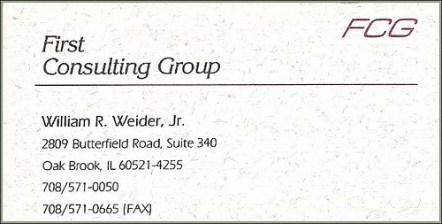
I believe I was at FCG during the golden age. There was not a lot of structure, but there were a lot of talented people figuring out this new industry. We were staying a few steps ahead of our clients. I remember working on a strategy project and we were arguing about the necessity for a PC network as part of the strategy. That’s how young the industry was.My FCG Business Card from 1988

Back in those days (1987 – 1990) Jim and Zan would shut down the entire company for one week and take us on a retreat in San Diego’s Pala Mesa resort. Somewhere I have have a picture of the staff at my first retreat – the first 50 FCG employees.

This was in important time in my life. I gained a lot of self-confidence and learned what it meant to love your work. I also had a lot of great mentors: Zan, Karen Reed, Julie Bonello and Steve Heck. I also loved my peers in the Chicago office: Pete and Andy Smith, Liz Krimendahl, John Hoben and many others. I still cherish my memories of Friday afternoons at Wrigley Field with this cast of characters. Work is great when you have a sense of camaraderie with your co-workers (which is why I am so happy now).

We were a small firm then. I remember our first $1M month. When FCG was sold to CSC they were a much different public company earning many times that. Good times, then. Good times, now.